 Search
 Customer
Longer drains, Lower cost: The role of Oil Analysis of Synthetic Engine Oils
By Joe Star | VPS Strategic Account Manager
A Demanding Environment
Across the United States, many vessels operating offshore and across the country's inland water ways are powered by high-speed engines. These engines provide one of the most demanding lubrication environments for engine oils to manage.
Engines frequently run at high loads, switching between long periods of continuous operation and shorter stints alternating between idling, standby and high loads during manoeuvring.
Such load changes, temperature variations and extreme conditions, along with the unique operating profile, vessels encounter, place extreme stress on engine oils. This results in leading Equipment Manufacturer’s (OEM’s) typically recommending drain intervals averaging only 250 operating hours. As a consequence, operators regularly assess the use of synthetic based oils, given the performance and commercial benefits that can be realised based upon extended drain intervals.
Whilst synthetic oils offer clear and significant performance advantages, the successful adoption and monetisation of a higher unit cost base product, depends upon implementing a structured and effective oil analysis program.
The Synthetic Difference
As engine designs, pressures and temperatures have continued to evolve to keep pace with fuel efficiency needs and requirements, a similar situation has evolved across lubricating oils. With higher pressures and temperatures, the stress on the oil has never been greater. Requiring sufficient viscosity, stability, oxidation control and wear protection capabilities, to be prioritised by lubricant formulators.
Synthetic oils are typically granted a longer drain interval by the equipment manufacturer (OEM) and are proven to be able to achieve this due to their high Viscosity Index (VI) capabilities and the largely uniform molecular structure when compared to mineral oils.
In mineral-based oils, molecules can vary in size and shape, leading to inconsistent lubrication and film creation and most importantly can exhibit a quicker breakdown under heat and increased rate of oxidation. This leads to the low 250 operating hour drain interval, typically recommended in operation.
In theory, Synthetic oils have been proven to be able to significantly extend drain intervals to more than 5-6 times the OEM recommended mineral equivalent, with no performance or reliability issues. However, monetising and ensuring that this is completed, requires a mindset shift from scheduled drain intervals to a condition-based approach based upon routine oil analysis. Adjusting and extending drain intervals can mitigate the most common issue which challenges this practice, which is external contamination in the form of fuel dilution or water ingress.
External Contamination and Fuel Dilution
Due to the operational nature of many vessels which use high-speed engines as a primary source of propulsion, fuel dilution and water ingress are some of the most common occurrences of external contamination, limiting the lifespan of lubricants within engines.
Through leveraging VPS’ MyLubes digital application, extracting results reported so far in 2026, it can be seen that approximately 26% of all high-speed engine oil analysis, in which distillate fuels were in operation, were reported as either a caution or an alert against relevant limits.
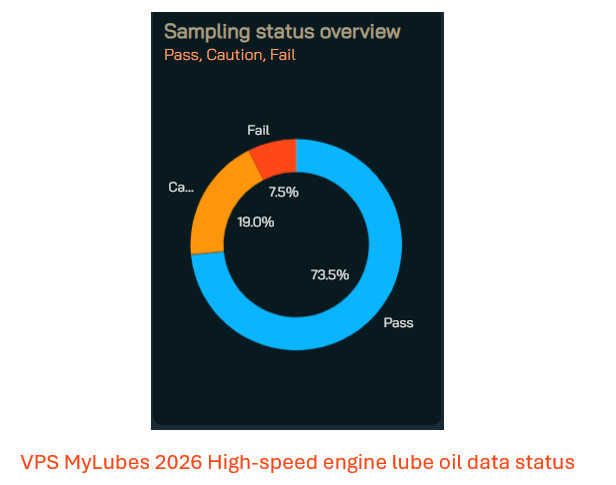
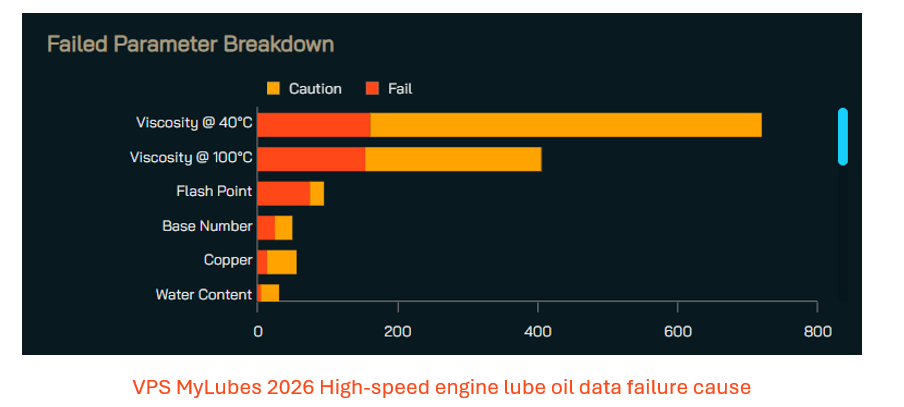
70% of the cautions and failures reported were through a combination of Viscosity, Flash Point or Base Number; highlighting the fuel and lubricant interaction; as Viscosity failures covered both elevated and lower Viscosity values. Elevated viscosity being a sign of oxidation and lower viscosity indicating fuel dilution respectively.
Fuel dilution is when fuel enters the crankcase or sump and mixes with the engine oil in the system. Typically, it is distillate fuel (Marine Gas Oil) which is the fuel choice for these engines.
Vessel’s that are more susceptible to fuel dilution are vessels which operate on frequent start-stop cycles, prolonged idling and low-load operation, where operational profiles require short bursts of high load, this can promote fuel ingress into the lubricating oil.
Critically, when looking to maximise lubricant lifespan, VPS data shows that approximately 23% of caution/failed high-speed engine oil analysis results are due to fuel dilution, highlighting that in these instances, either mineral or synthetic based lubricants are not being maximised.
Fuel dilution has a direct impact on overall lubricant performance, notably:
- Viscosity reduction, leading to increased metal to metal contact
- Reduced flashpoint, leading to safety risks and onboard management requirements
- Accelerated lubricant degradation and corrosion, leading to reduced component lifespan
Mineral and Synthetic based oils are both equally susceptible to fuel dilution occurring. In addition there are financial considerations to manage fuel dilution when Synthetic products are in place, due to the increased unit cost. Ensuring prompt detection and resolution is the most effective tool to effectively minimise the real-world impact of fuel dilution on lubrication strategies.
Monetising a more costly lubricant
Whilst typical mineral based engine oils drain intervals are approximately 250-500 hours, depending upon the engine make and model, synthetic oils have been able to extend drain intervals to over 2000 hours. The benefit to operators is clear on paper, with synthetic oils typically costing 2-3 times more than mineral equivalents. Provided drain intervals are extended beyond 3 times the mineral equivalent, a significant budget saving can be achieved by the operator.
Notably this creates a shift in operating mentality, moving from a time-based approach to a condition-based assessment of oil quality; meaning that a robust oil analysis programme and sampling interval becomes more important, not less.
In addition to providing the most effective early warning with regards to fuel dilution and contamination, a robust Oil Condition Monitoring (OCM) programme is the critical enabler to safely and reliably extending drain intervals with synthetic, or mineral based engine oils.
At a high level, based upon operational experience, VPS’s core recommendations for an effective programme to support extended drains include:
- Sampling intervals at least twice per drain cycle
- Increasing frequency if fuel dilution is observed, or engines are operated at low loads for extended periods
- In practice, sampling every 200-300 hours is strongly recommended, typically 6-8 times per drain interval for Synthetic lubricants
- Oil samples to be taken following representative running of the engine
- Close monitoring of any deviation of trends, through digital platforms
- Integration of lubricant sampling and data into Maintenance systems
- Assessment of common limiting factors across fleets and engine types
Lowering Cost
Fundamentally, with high-speed diesel engines being the workhorse of inland waterborne transportation and offshore vessels; lubricants will be a critical part of the total system and subsequent operating cost.
Synthetic based products offer a benefit on paper when compared to mineral oils, however if such products are consumed at the same rate as mineral oils, there is no benefit to expenditure, and more money is spent for the same outcome.
Drain intervals can only be safely extended, and subsequently monetised, through a robust oil analysis programme. In the demanding environment of inland and offshore operations, oil analysis provides more than a measure of lubricant condition; it also delivers valuable insight into the condition of the engine itself. By routinely monitoring oil health, identifying contamination, wear trends and degradation at an early stage, operators can take timely corrective action, protect engine reliability, extend oil life and ultimately reduce operating costs
For more information on how VPS can assist in improving vessel operational efficiency and potential cost savings please contact: sales@vpsveritas.com