Neil Chapman: VPS MD-Americas
Stanley George: VPS Group Science & Technical Manager
Steve Bee: VPS Group Marketing & Strategic Projects Director
In an emergency at sea, there is no second chance. If a lifeboat engine fails to start, an emergency generator cannot take load, or a diesel driven fire pump loses power, the consequences can be immediate and serious. Fuel is only one part of emergency equipment reliability but it is essential and can remain largely unseen as the equipment sits on standby for prolonged periods. Careful selection of this fuel can minimise the risks of failure when it is needed most.
Executive Summary
Safety of Life at Sea (SOLAS) regulations, require emergency equipment to be immediately available and capable of performing its intended safety function. The fuel carried within this key safety equipment must be suitable and maintained in a condition that ensures reliable operation of lifeboats, emergency generators and other emergency assets when called upon. To support SOLAS regulations and requirements, there is within ISO8217, a special-purpose distillate grade fuel, ISO-F-DMX, specification, specifically intended for use in emergency equipment. With DMX-grade fuel, ISO8217 has specified a set of parameters and test scope. The properties of this fuel are designed to ensure rapid ignition after long idle periods, low-temperature operability, long-term storage stability and absence of biodiesel-related degradation risks. Accordingly, these properties include a relatively high minimum cetane index, defined low temperature performance and the requirement that the fuel is free of FAME. In normal marine operations, DMX is suitable for the diesel engines fitted to lifeboats, rescue boats, emergency generators, diesel driven emergency fire pumps and, where fitted, diesel driven emergency compressors. [1,2]
However, in practice, emergency equipment tanks are not always filled with DMX. VPS has noted that, in a significant number of cases, fuels other than DMX are used in emergency equipment tanks, including DMA, DMB, unspecified marine diesel and automotive diesel. These products should not automatically be regarded as equivalent to DMX, as their FAME content, ignition quality and cold flow characteristics can differ. The condition of the fuel can also change when it remains in storage for extended periods.
A recent VPS review of emergency equipment fuel samples found that 48% were not identified as DMX, 28.6% contained FAME above the 0.1% level, and 6.2% showed microbial contamination. These figures are not equipment failure rates, but they show that fuel selection and the condition of the stored fuel deserve greater attention as part of routine emergency equipment assurance. As such, the use of DMX is less about fuel economics and more about reliability of safety-critical equipment when lives are at risk.
Why DMX Grade Matters
ISO 8217:2024 specifies DMX with a kinematic viscosity at 40°C of 1.400 to 5.500 mm²/s, a minimum cetane index of 45.0, a maximum cloud point of -16°C and a minimum flash point of 43°C. The standard also states that DMX shall be free of FAME. Unlike DMA and some other distillate grades, no density limit is specified for DMX. [1]
The cetane index requirement is relevant to ignition quality. The minimum cetane index for DMX is 45.0, compared with 40.0 for DMA and DMZ and 35.0 for DMB. This is useful for equipment expected to start promptly after remaining idle for long periods.
Cold flow performance is equally important. For DMX, the maximum cloud point is -16°C. At or below the cloud point, wax crystals begin to form and may eventually restrict small bore fuel lines and filters. Fuel used in emergency equipment should therefore remain suitable for the lowest ambient temperature in which the equipment may be required to operate. [1,2]
ISO 8217:2024 requires DMX, DMA, DFA, DMZ and DFZ fuels to appear clear and bright. If the fuel is dyed and not transparent, preventing this visual assessment, water shall not exceed 200 mg/kg when determined in accordance with ISO 12937. [1]
The requirement for DMX to be free of FAME is also relevant to storage. FAME has a greater affinity for water than conventional hydrocarbon distillate fuel and can influence oxidation stability and storage behaviour. Where water is present, microbial growth can develop at the fuel/water interface, with the potential for sludge formation, deposits and filter blockage. [1,2]
Key Fuel Related Risks in Emergency Equipment
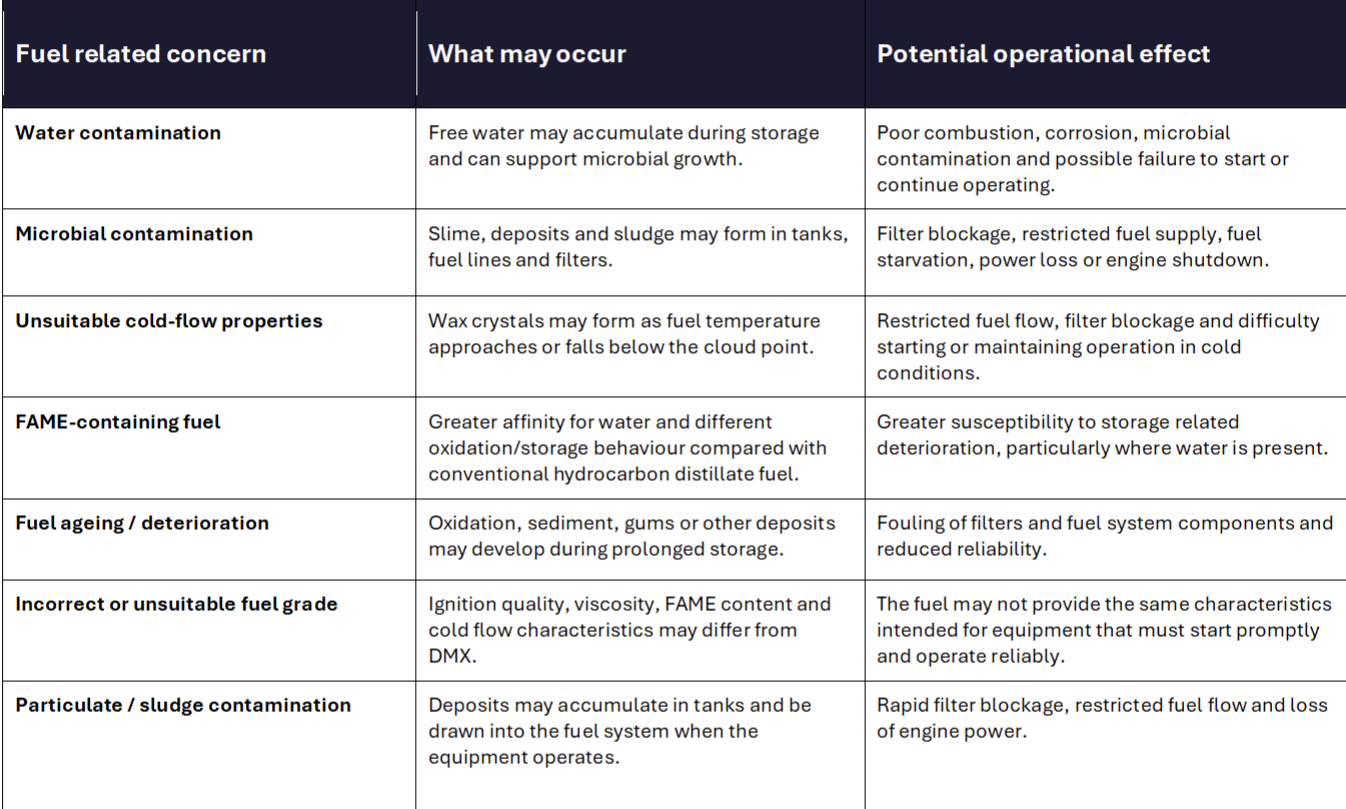
The concern is not limited to whether an engine can run on a particular fuel. Emergency equipment may remain on standby for long periods and then be expected to start promptly and sustain the required duty. The main fuel related pathways are summarised below.
Lifeboat Fuel Capacity
SOLAS Chapter III, Regulation 31.1.4 (Survival Craft Motor Requirements) states: “Sufficient fuel, suitable for use throughout the temperature range expected in the area in which the ship operates, shall” be provided to run the fully loaded lifeboat at 6 knots for a period of not less than 24 hours. This requirement is important as it is here that SOLAS explicitly refers to fuel quality, requiring the fuel to be suitable for the environmental conditions in which the vessel operates.
Emergency Generator Failures - What Is Seen in Practice
For emergency generators, two important functional failures are repeatedly encountered during inspections: the generator fails to start, or it starts but does not provide the required electrical power or take the required load on the emergency switchboard.
SOLAS Chapter II-1, Regulation 42 (Passenger Ships) and Regulation 43 (Cargo Ships) states: “A self-contained emergency source of electrical power shall be provided.” The regulations further require that the emergency source has sufficient capacity and endurance to supply all essential emergency services for the prescribed period. The emergency generator must have an independent fuel supply sufficient to maintain operation for the required duration.
AMSA specifically identifies both situations during Port State Control inspections. DNV also reported a 2026 detention case where an emergency generator started during a simulated blackout but repeatedly failed to take load on the emergency switchboard. [3,4]
Fuel quality is only one possible cause. Starting batteries or starting air systems, controls, breakers, governors, cooling systems and other mechanical or electrical components can also result in failure. Fuel related problems remain important because the fuel may stay in a dedicated emergency tank for long periods with very little turnover.
A documented example occurred on an Offshore Support Vessel: The emergency generator was started and connected to the emergency switchboard but later shut down. The investigation found that the generator fuel filters were clogged, probably as a result of bacterial contamination, causing fuel starvation. A separate electrical problem with the automatic cooling air damper also contributed to high temperature shutdown. Although the generator had been regularly tested, it was generally not run on load for extended periods and there was no planned maintenance task for testing the emergency generator fuel tank for bacterial contamination. [5]
This case illustrates why a short routine start test, although essential, does not by itself confirm that the fuel system and emergency equipment will remain reliable during sustained operation.
Emergency Fire Pumps
Under SOLAS Chapter II-2, Regulation 10 (Fire Fighting), where an emergency fire pump is diesel driven, it must be independently powered and capable of operating if the main machinery space is unavailable, ie the fuel supply must allow the pump to perform its emergency function whenever required.
Fuel Condition During Storage
Emergency equipment fuel can remain unused for months and, in some cases, considerably longer. During this period, water may enter through contaminated fuel, condensation or tank system issues. Water can affect combustion and reliable starting, and it creates the conditions required for microbial growth.
Microbial contamination can produce slime and deposits, contribute to tank corrosion, foul injectors and block filters. Where fuel supply is restricted, the result can be loss of power or engine shutdown through fuel starvation. [2,5]
Cold flow properties also require attention. A fuel may have an acceptable pour point while having a much higher cloud point. Wax formation can therefore begin well before the fuel reaches its pour point. For emergency equipment operating in cold climates, cloud point and, where relevant, other cold flow characteristics need to be considered against the expected ambient temperature. [1,2]
Fuel ageing and oxidation can also lead to colour change, sediment or gum formation. The concern is therefore not limited to whether the fuel met a specification when first delivered; its condition after prolonged storage is equally important.
Recommended Onboard Controls and VPS Monitoring Approach
Fuel intended for emergency equipment should be clearly identified and ideally ISO-F-DMX should be specified when these tanks are filled or replenished. The Bunker Delivery Note, Certificate of Analysis or other supply documentation should be reviewed to confirm the product supplied.
Where DMA, DMB, automotive diesel or another distillate is used instead of DMX, it should not be assumed to have equivalent properties. Particular attention should be given to FAME, viscosity, ignition quality, flash point, cloud point and other cold flow properties, water and the general condition of the fuel.
The initial fuel placed into the emergency equipment tank should be tested. Following this initial assessment, VPS recommends routine calendar based monitoring at approximately three month intervals. The routine package should cover the basic parameters needed to assess fuel condition. Based on the results, VPS may recommend additional targeted tests and/or a shorter testing interval where deterioration, contamination or other abnormal findings are identified.
A new representative sample should also be considered following significant replenishment, fuel replacement, contamination, tank cleaning or any event that materially changes the fuel held in the emergency equipment tank.
Tank bottoms and drains should be checked routinely for free water and deposits. Any free water should be removed and its source investigated. Where sludge, unusual appearance, repeated filter blockage or other abnormal conditions are observed, further fuel assessment should be carried out rather than waiting for the next scheduled test.
Emergency engines should be operated and tested in accordance with vessel procedures, statutory requirements and equipment instructions. Where the approved test procedure allows, operation under load provides additional assurance that the fuel supply, filtration, cooling and electrical systems can sustain the required duty.
Lubricating Oil Monitoring in Emergency Diesel Engines
Fuel quality should not be considered in isolation. The condition of the engine lubricating oil is also important, particularly for emergency generators and other emergency diesel engines that remain on standby for most of their operating life.
On some installations, fuel remains under positive static head from a service or header tank while the engine is stopped. Leakage through injectors, injection pump components or other fuel system components can allow fuel to enter the combustion space and subsequently the crankcase. Fuel dilution can also occur through other engine faults during operation.
This is particularly relevant to emergency engines because they are normally operated only for short periods during routine testing and may otherwise remain stationary for long periods. A small continuing fuel ingress may therefore remain unnoticed between tests.
Distillate fuel is substantially less viscous than engine lubricating oil. Even a relatively small quantity entering a small volume sump can therefore cause a measurable reduction in lubricating oil viscosity and oil film strength. Fuel dilution can also reduce the lubricating oil flash point. An unexpected reduction in viscosity or flash point, an increase in sump oil level, or other evidence of fuel dilution should be investigated rather than corrected only by changing the oil.
Water contamination can have a similarly significant effect where the sump capacity is small. Where FAME containing fuel has inadvertently been used, fuel ingress may also introduce FAME derived material into the lubricating oil and may justify additional targeted investigation.
VPS therefore recommends that lubricating oil from emergency diesel engines is included in the routine calendar based monitoring programme. Routine analysis should cover the basic parameters needed to assess oil condition and identify possible contamination. Based on the results, VPS may recommend additional tests and/or a shorter monitoring interval. This allows developing fuel dilution, water contamination, oil degradation or abnormal wear to be identified before equipment reliability is affected.
Conclusion
SOLAS regulations are very clear in stating, emergency equipment has one fundamental requirement: it must operate when needed. The condition of the fuel held in these systems, sometimes for extended periods with very little turnover, is therefore a critically important part of maintaining that readiness.
ISO8217 highlights a specific fuel grade for use in emergency equipment, ISO-F-DMX. This fuel grade provides properties suited to this duty, including defined low temperature performance, a relatively high cetane index and the requirement that the fuel is free of FAME. Alternative distillate fuels should not automatically be regarded as equivalent, simply because the engine is capable of operating on them.
VPS findings show that a significant proportion of emergency equipment fuel samples are not identified as DMX, while FAME and microbial contamination are also being detected. These findings do not represent equipment failure rates, but they demonstrate that fuel selection and the condition of fuel during storage require greater attention.
VPS recommends testing the fuel when first placed into the emergency equipment tank, followed by routine calendar-based monitoring at approximately three month intervals. Abnormal results should trigger additional targeted testing and/or a shorter monitoring interval. Routine lubricating oil analysis should form part of the same programme, particularly to identify fuel dilution, reductions in viscosity or flash point, water contamination and abnormal wear.
A short routine start test confirms that the engine can start at that moment. It does not necessarily confirm that the fuel system, engine and associated equipment will continue to operate reliably under sustained emergency conditions. A combination of correct fuel selection, stored fuel monitoring, tank management, routine lubricating oil analysis and appropriate operational testing provides a more complete assessment of emergency equipment readiness.
VPS Laboratory is available to support with targeted testing programs, specification reviews, and technical consultations. Contact your VPS representative or visit sales@vpsveritas.com for further supporting information.
Technical References:
[1] ISO 8217:2024. Petroleum products - Fuels (class F) - Specifications of marine fuels. Table 1 and general fuel-composition requirements.
[2] VPS. Fuel quality in emergency equipment, 13 February 2024. Link
[3] Australian Maritime Safety Authority. Port State control inspection common SOLAS issues - Emergency generators. Link [4] DNV. Port State Control - Q1 2026 Detention review and other updates. Link
[5] Australian Transport Safety Bureau. Engine room fire on board MPV Everest, Southern Ocean, 5 April 2021 - final investigation report. Link
Technical note: This article provides general technical guidance. Equipment manufacturer instructions, vessel-specific arrangements, statutory requirements and the vessel Safety Management System remain applicable.
 Search
 Customer